
“How many sets per muscle per week” is one of the most searched questions in lifting, and the research gives a surprisingly clear starting point. This guide summarises what the studies found, what they could not answer and how to use the numbers without overthinking them.
Key takeaways
- Studies found more weekly sets per muscle went with more growth, up to about 10 or more sets.
- 10 hard sets per muscle per week is a sensible target for most people.
- Beginners can do less and still grow, and advanced lifters may need more.
- Sets only count if they are hard, close to failure with good form.
What the research found
A 2017 meta-analysis pooled 15 studies and sorted training into groups of fewer than 5, 5 to 9 and 10 or more weekly sets per muscle. It found a graded dose-response: more sets went with more muscle growth. The authors noted the data could not say whether going far beyond 10 sets adds more (Schoenfeld, Ogborn and Krieger, Journal of Sports Sciences, 2017). A later systematic review of volume studies also pointed to ranges around 10 or more weekly sets, with some suggesting 12 to 20 for trained people, though that rests on fewer studies (systematic review, 2022).
The evidence: Training each muscle at least twice a week beat once a week when weekly volume was matched. Read the study.
A practical way to use this
- Start near 10. Aim for about 10 hard sets per muscle per week. Beginners can start lower, around 6 to 8.
- Split it over two days. Five sets on two days beats ten in one session for most people.
- Keep sets hard. End each set with one or two reps left in the tank.
- Add slowly. If a muscle stalls for a month, add one or two sets, not ten.
- Watch recovery. More is not better if your lifts are going down.
| Muscle group | Example exercises | Sets per week (start) |
|---|---|---|
| Chest | Bench press, incline press, push-ups | 8 to 10 |
| Back | Rows, pulldowns, pull-ups | 8 to 10 |
| Legs | Squat, leg press, Romanian deadlift | 8 to 10 |
| Shoulders | Overhead press, lateral raise | 6 to 10 |
| Arms | Curls, triceps pushdown | 4 to 8 |
These are starting points, not rules. Compound lifts also train other muscles, so your biceps already get work from rows. How you split these across the week is covered in our split guide.
What this does not tell you
Most volume studies were short and used trained young men, and “a set” was not always the same across studies. The numbers describe averages, not you. Use them to get started, then let your own progress guide changes, using a workout log.
How Hey Broski helps
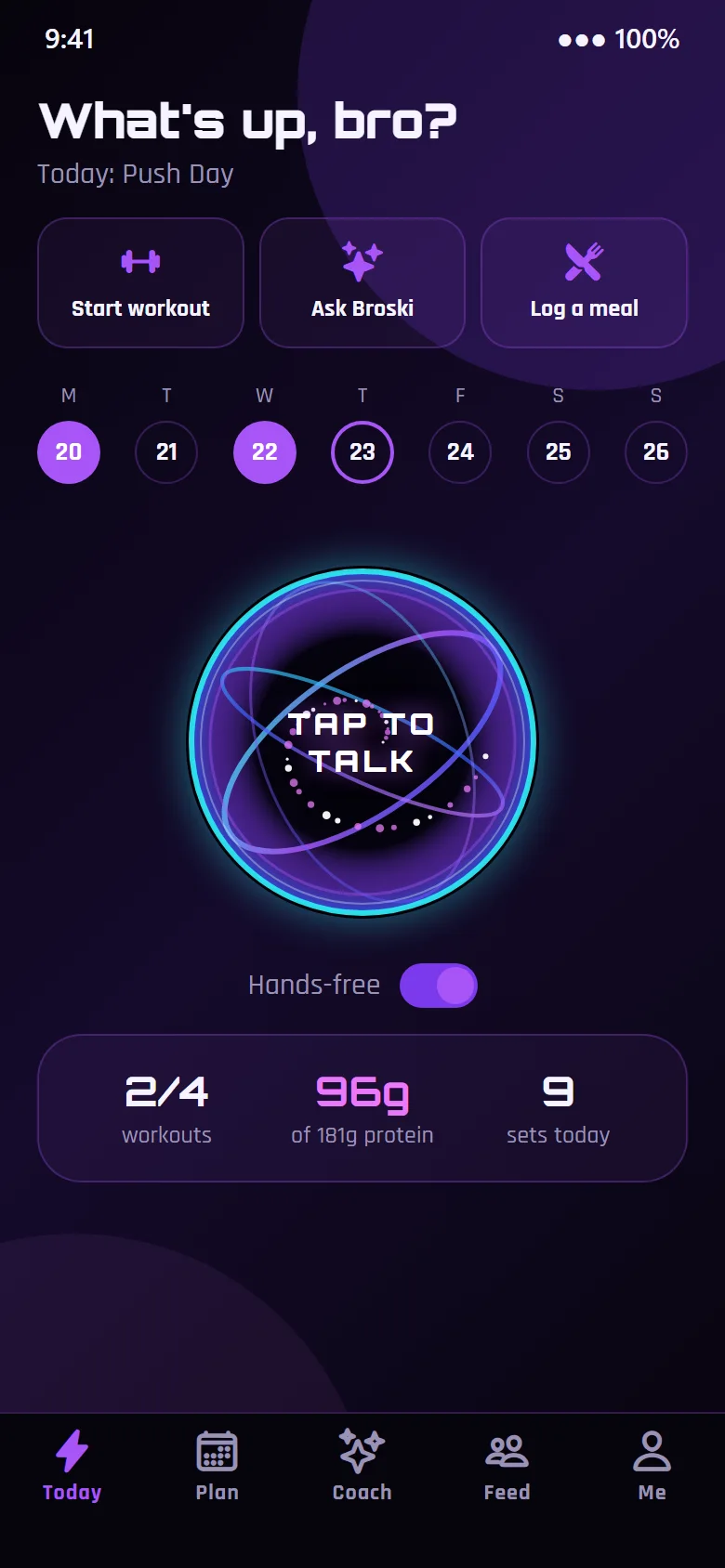
Counting sets is easier when logging is quick. Say “3 sets of 10 squats at 135” and Hey Broski logs all three, and the Today screen shows how many sets you have done so far. Your history shows each lift, so you can add up your week.
Get Hey Broski on Google Play A hands-free fitness logging app. No ads, and an AI coach when you want one. iPhone coming soon.
Frequently asked questions
How many sets per muscle per week should a beginner do?
About 6 to 10 hard sets is a sensible start. Beginners respond to less volume, so you do not need to max it out.
Is 20 sets per week too many?
For some trained lifters it works, but the evidence for going beyond 10 is thinner. Add volume gradually and watch your recovery.
Do all sets count the same?
No. Hard sets, close to failure with good form, count. Easy warm-up sets do not.
How often should I train each muscle?
At least twice a week is a good target, according to a meta-analysis of frequency studies.
Keep reading
- Progressive overload for beginners: how to make those sets harder over time
- Which split is best?: fit your sets into a weekly plan
- How much protein per day: fuel the growth
Choosing between apps? See the side-by-side comparison chart of eight AI fitness apps.
Get Hey Broski on Google Play A hands-free fitness logging app. No ads, and an AI coach when you want one. iPhone is coming soon. See what’s new.