Which workout split is best? Ask ten lifters and you will get ten answers. The honest answer from most coaching sources is that the best split is the one that fits your schedule, lets you recover and that you will keep doing. This guide compares the big three so you can choose in about two minutes.
Key takeaways
- 3 days a week: full body. 4 days: upper/lower. 5 to 6 days: push/pull/legs.
- No split beats the others if total weekly work and effort are the same.
- Training each muscle about twice a week is a good target.
- Consistency and progressive overload matter more than the split.
Full body
You train every major muscle in each session, usually three non-consecutive days a week. Best for: beginners, busy people, anyone who sometimes misses a day. A missed session does not leave a muscle untrained for the week. Watch out for: long sessions if you add too many exercises.
Upper/lower
Two upper-body days and two lower-body days across four sessions. Best for: people who can train four days and want legs to get real attention. Each muscle gets hit twice a week without marathon workouts.
Push/pull/legs (PPL)
Push (chest, shoulders, triceps), pull (back, biceps) and legs. Run it once for three days or twice for six. Best for: people who like training often and want shorter, focused sessions. Watch out for: legs can get less attention if you run it as a 3-day split, and six days needs good recovery.
| Split | Days per week | Frequency per muscle | Good for |
|---|---|---|---|
| Full body | 3 | 2 to 3 times | Beginners, busy schedules |
| Upper/lower | 4 | 2 times | Balanced strength and size |
| Push/pull/legs | 5 to 6 | 1 to 2 times | Higher volume, more time |
Does the split matter for muscle growth?
Research suggests that training a muscle at least twice a week beats once a week when total volume is the same (Schoenfeld et al., Sports Medicine, 2016). That favours full body, upper/lower and PPL run twice, and it is why old-school once-a-week “bro splits” are not the best use of a week. Past that, what you do inside the split matters most: enough hard sets (see how many) and progressive overload.
How to choose
- How many days can you reliably train? Pick the split for that number.
- Are you new? Start full body.
- Do you miss days? Choose a split where missing one hurts least.
- Run it for 8 to 12 weeks before judging.
How Hey Broski helps
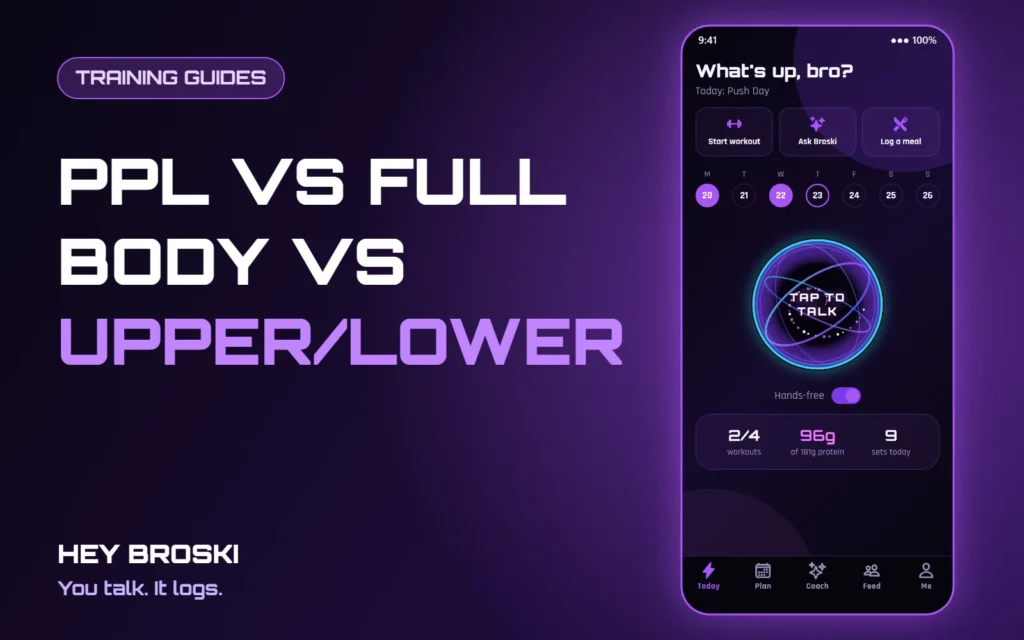
Hey Broski builds a weekly plan on a calendar for your goal and days, and your coach can change it by voice: swap a day, add meals or take days off. Say “what is next in my plan?” mid-session instead of scrolling.
Get Hey Broski on Google Play A hands-free fitness logging app. No ads, and an AI coach when you want one. iPhone coming soon.
Frequently asked questions
Is push/pull/legs better than full body?
Not inherently. For muscle growth, results are similar when weekly volume and effort match. PPL suits people who train 5 to 6 days, and full body suits 3 days.
How many days a week should I work out?
Three to four days is a strong starting point for most people. Add days only if your recovery and schedule allow it.
What is the best split for beginners?
Full body three days a week is simple and forgiving. Add an extra day later if you want.
Can I switch splits?
Yes. Change after 8 to 12 weeks if your schedule or goals change, and keep your log going.
Keep reading
- How many sets per muscle per week: what to fit inside your split
- Progressive overload for beginners: how to get stronger inside any split
- Your first 30 days of training: start with a simple habit plan
Choosing between apps? See the side-by-side comparison chart of eight AI fitness apps.
Get Hey Broski on Google Play A hands-free fitness logging app. No ads, and an AI coach when you want one. iPhone is coming soon. See what’s new.